Vealth · Regen Network · Written for Regen Network Development
A course for Regen Network, across all directions.
A roadmap for the ledger's infrastructure on a utility basis, written for RND at its request, with vealth as Regen Network's app for digital-to-physical regeneration: provisioning ecological wealth. Here it is: the thesis, what happens if everyone does it, where things stand, the map, the steps, what still has to be built, the money, and who is taken care of how.
Version 7, September 2026. By EcoWealth, steward of the Regen Tokenomics Working Group. Unaffiliated with Regen Network Development PBC, not reviewed or endorsed by them. The votes recorded here passed on regen-1; every step still ahead needs its own vote or its own build.
The whole course at a glance
Four lanes, every track, its state and its next move.
DoneLiveBuildingNextVoteCandidate
The ledger
The program
The money
The markets
Each bubble links to the place that proves it. The same map as an image: roadmap-map.svg.
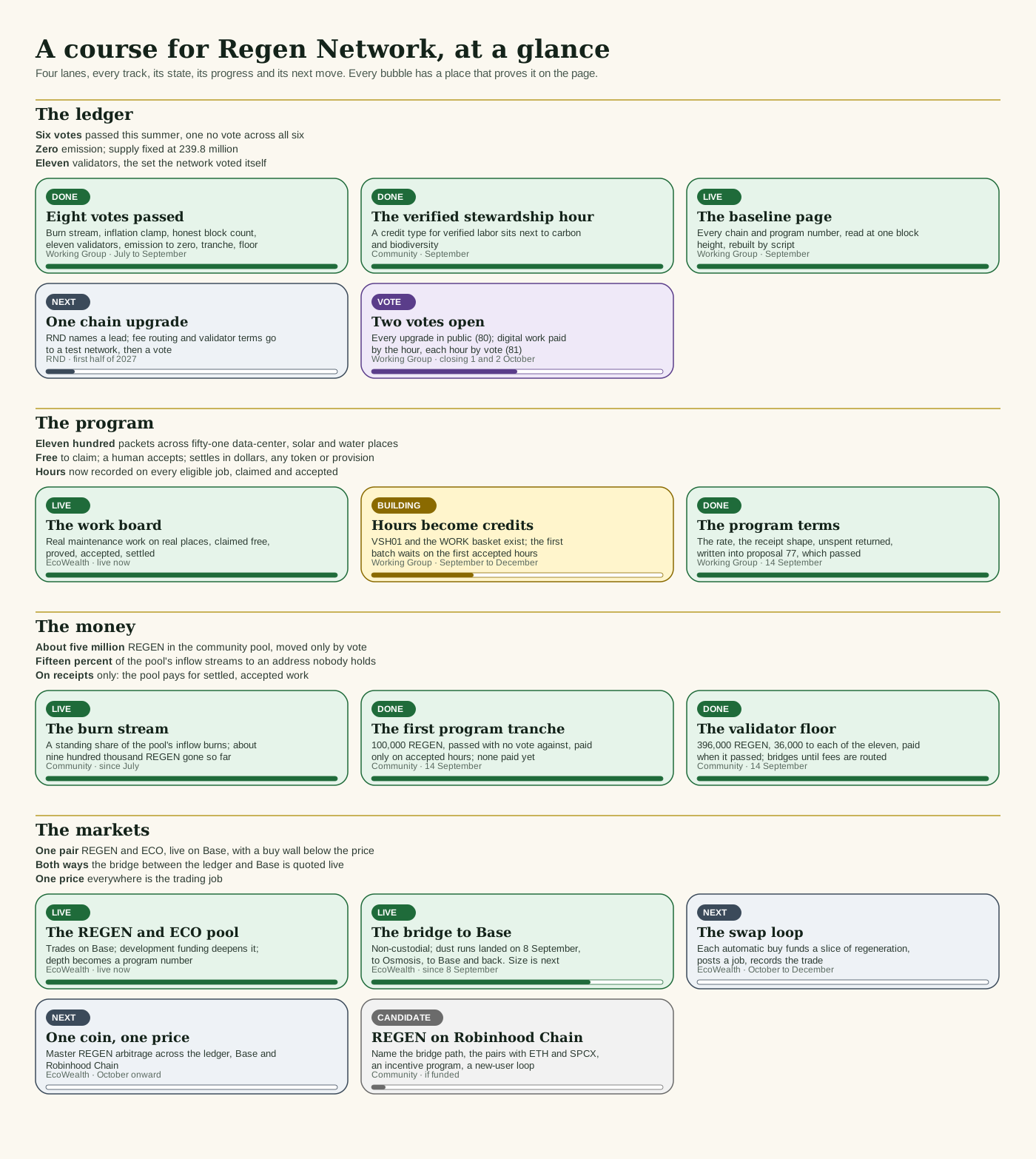
In one screen
The course, in five lines.
- What this is. A course for Regen Ledger to pay for its own infrastructure from use, with vealth as Regen Network's app for digital-to-physical regeneration: a public work program that turns settled hours of real labor into credits on the ledger.
- Done. Eight votes the Working Group put up have passed, with a single no vote across all eight: a burn stream, an inflation clamp, an honest block count, a validator set of eleven, emission to zero, the verified stewardship hour as a credit type, and in September the first program tranche and the validator operating floor. The first credit class (VSH01) and the WORK basket exist on the ledger. The bridge has carried REGEN to Osmosis and to Base and back. The baseline page is live.
- Next. The first accepted hours paid from the tranche, which open the first project and the first credit batch; proposals 80 and 81, closing on 1 and 2 October; then a lead for the upgrade.
- Money. The pool pays for settled work only, on receipts. Development funding buys the build. No printing, no staking, no burning by the steward.
- What we ask of RND. Votes on proposals 80 and 81 before they close, a lead for the upgrade and its notices in public, its retirement counts, the first retirement of verified stewardship hours, and the marketplace fee values.
What changed since version 6
Two votes passed, a token made, a bridge crossed, two votes open.
Version 6 went to RND on 6 September. This is what landed on regen-1 and on vealth after it, read on the chain at block height 29,019,100 on 27 September 2026. What has not happened yet is said as plainly as what has.
- The first program tranche passed. Proposal 77 closed on 14 September: 53.6 million REGEN yes, none against. 100,000 REGEN moved from the pool balance into the payout account, EcoWealth's own, to be paid only against accepted hours at the rate the proposal states (10,000 REGEN per accepted hour), with the receipt shape written into it and anything unspent after 365 days returned to the pool. None of it has left the payout account yet, because no hours have been accepted under it. Every payment will show on the tranche ledger.
- The validator operating floor passed and paid. Proposal 78 closed on 14 September: 53.7 million yes, none against. 396,000 REGEN, 36,000 to each of the eleven bonded validators, paid by the chain when it passed. It is the first money the validators have received beyond gas since emission stopped.
- The liquidity spend passed. Proposal 76, the LiquidityDAO's 867,000 REGEN, closed on 11 September with the Working Group's yes. Together with 77 and 78 it took the pool from about 5.04 million REGEN to 3,672,756.
- The WORK token exists. On 8 September the Working Group created the WORK basket on regen-1 (
eco.uVSH.WORK): put a VSH01 credit in and one WORK token comes out, and it goes back the same way. It is the second basket the ledger has ever had. Its 1,000 REGEN creation fee and VSH01's 5,000 were burned, which is why supply reads 239,826,669.59, six thousand lower than in version 6. - The bridge carried REGEN both ways. On 8 September: 100 REGEN from the ledger to Osmosis over the plain IBC channel; 3,000 REGEN from the ledger to Base as axlREGEN through Axelar, of which 2,856.6 landed (the corridor's toll that day was 143.4 REGEN); and 1,000 REGEN from Base back to the ledger with no toll. Each landing was read on the destination chain. One router now quotes REGEN across regen-1, Osmosis and Base, and the board's agent tools prepare either direction for the caller to sign.
- The chain upgraded, and stopped for an hour and a half. Proposal 79, Regen Ledger v7.3.0, not the Working Group's, passed. At height 28,971,032 on 24 September no blocks were produced from 14:58 to 16:29 UTC while validators upgraded, and three of the eleven were late. No notice went up on the Regen forum before or after. The Working Group posted what happened the same day (forum thread 637). As of this version the ecostake public endpoint that version 6 named as an example still answers at the height the chain stopped at, so this page now names another.
- Proposal 80: every upgrade in public. The Working Group's answer to the halt, a text standard: every chain upgrade announced ahead of its height, tracked while it happens, and reviewed after. In voting until 1 October: 14.7 million yes, none against, where quorum needs about 32.4 million.
- Proposal 81: digital work paid by the hour, each hour by vote. A text proposal that adopts one published authority, identified by its hash: 5,000 REGEN per accepted hour of digital work for the chain, at most 10 hours and 50,000 REGEN per 30 days, for 180 days, then it lapses unless a new vote renews it. Every payment is its own governance proposal that names the work, the hours and the evidence, anchored on the ledger before the proposal goes up, so the network sets the pay again each month by passing or rejecting it, and the rate itself changes only by a vote naming a new hash. In voting until 2 October: 22.0 million yes, none against.
- The steward runs on the board. An hourly loop reads the candidate packets for proposal 77 and checks them against its rules, and one command walks every step of proposal 77 for a real packet, from claim to payment to credit, naming which steps wait on an outside fact and which on a person.
- Not yet. No verified-stewardship-hour project or batch exists; VSH01 opens its first project with the first accepted hours. The anchor leg was armed on 13 September, but the ledger shows no program anchor since 3 August, so its first broadcast has not landed. The swap loop is still switched off.
The thesis
Regeneration will have to fight for its place.
The next decade builds data centers, solar fields and robots faster than anything ecological has ever moved. Regeneration keeps up by using the same technology: agents that write and verify work, compute that turns a settled hour of real labor into a credit, and money that moves only on proof.
That machine already runs. It is called vealth, and this course proposes it as Regen Network's app for digital-to-physical regeneration. A public board posts real maintenance work on real places. Anyone with a wallet claims a job for free, proves it with photos and location, and a human accepts it. The worker is paid in dollars, in any token, or in provision (food, housing, the life). Agents write the work, check the proof and keep the records. Every place has a standing that rises only from settled work and lapses when the work stops.
Regen Ledger is where a settled hour becomes a credit of record. The vote that adds the verified stewardship hour to Regen's registry puts vealth's unit of work next to carbon and biodiversity. So the roles are fixed: vealth leads the program, Regen keeps the book, the community pool pays for settled work, and the REGEN coin is worth what the book carries. Put plainly, vealth is Regen Network's app for digital-to-physical regeneration: the place where a credit, a payment or a line of compute becomes an hour of real work on real ground, and the ground's improvement comes back to the ledger as a record. That is what provisioning ecological wealth means.
The product test under all of it: AI and blockchain have to be so easy and so logical to opt into that it is hard not to do both. That is what yields real productivity, alignment with nature, and more abundance.
If everyone did this
It is not complicated.
Imagine every data center, solar field, town and robot fleet posted the maintenance it owes to the ground around it, and paid on proof. Every hour of that work would land as a credit on one book. Every pool of money meant for nature would pay on receipts instead of promises. Validators would be paid by that flow. The coin would be worth the size of the book. Regen's registry would be the standard record of verified labor on the planet, and RND would be the company that keeps it, with vealth as the app people and agents use to do the work.
They should be doing this. That is the whole offer, and the rest of this page is how.
Where things stand, late September 2026
Eight votes on the ledger, a board full of work, a pool on Base.
The mint now issues — REGEN a year. Agents author and verify work around the clock. A REGEN and ECO trading pool is live on Base with a standing REGEN buy wall below the price, and the house runs small automatic buys twice a day that the swap loop will ride. On Robinhood Chain the board's twin contract is live; the house wallet buys there and does not provide liquidity. Upstream, the Cosmos software Regen runs on has shipped the new version and the proof-of-authority module Regen's plan needs; that module's current release runs on Cosmos SDK v0.55.0 and CometBFT v0.40.0, and since the v7.3.0 upgrade regen-1 runs SDK v0.53.6 and CometBFT v0.38.21, so it is still two minor lines behind on each, not one.
The community pool paid out three votes in September: the LiquidityDAO's 867,000 REGEN (proposal 76, passed 11 September), the program tranche's 100,000 and the validator floor's 396,000 (proposals 77 and 78, passed 14 September). Two more of the Working Group's are in voting: the upgrade coordination standard (proposal 80, to 1 October) and the digital stewardship authority (proposal 81, to 2 October).
Built since the votes. The board records verified hours on a job, claimed by the worker and accepted by the human, and marks which jobs a credit batch may draw from. The first verified-stewardship-hour class exists: VSH01, created on the ledger on 2026-09-07, the class fee burned, EcoWealth's account as admin and issuer. The WORK basket that turns VSH01 credits into one token each followed on 2026-09-08. The bridge carried REGEN to Osmosis and to Base and back the same day. An hourly loop watches proposal 77's candidate packets. The Regen Compute retirement count reads from three independent sources that agree. These numbers, read at one block height and rebuilt by script: the baseline.
What is on the ledger, and how the numbers go up
Four records make a claim real. Ten numbers are the pulse.
Regen Ledger is the one public book where an ecological claim exists as four records anyone can read: a class (the rules), a project (the place), a batch (the issuance) and a retirement (the permanent certificate). Credits sell for real dollars on the ledger's own marketplace, the community pool is governed by vote, the data module anchors any record for a fraction of a cent, and since this summer the ledger holds a labor unit, so an hour of verified work can be recorded next to a ton of carbon. The numbers below are the ledger's pulse. Every step in the course is a lever on one of them.
Regen's own account of its scale, published on its forum in December 2025 (The State of Regen 2025, Gregory Landua, thread 565), carried here as Regen's figures, not re-audited:
| Regen's figure, December 2025 | Value |
|---|---|
| Live tokenized ecological credits | $9.3 million |
| Purchased and retired | $2.4 million |
| Credits issued, and retired | 6.1 million issued, 1.4 million retired (about 23 percent) |
| Land under verified regenerative management | 420,000 hectares and more |
| Carbon sequestered, estimated | 5.2 million tonnes of CO2e |
| On-chain market volume in 2025 | about $2.7 million |
| Participants | over 20,000 |
The chain figures in the next table were read at block height 29,019,100 on 27 September 2026, except fee income, the price of a unit of use and trade, which are from block height 28,678,615 on 5 September; credit units are batch supplies, and Regen's issued count uses its own method and is larger. Both are true on their own terms; the roadmap moves both.
| On the ledger | Today | What moves it up | Where in the course |
|---|---|---|---|
| Credit classes | fourteen, VSH01 the newest | The first verified-stewardship-hour class, then one class per method that needs its own rules | Step 4 |
| Projects | one hundred eighty-eight | Every place on the board with settled hours becomes a project | Step 6 |
| Credit batches | eighty | Each settled batch of hours becomes a batch of verified-stewardship-hour credits | Step 6 |
| Credit units issued | about 1.82 million, all types | Hours settled on the board and accepted by a human, issued as credits | Steps 5 to 7 |
| Credit units retired | about 160 thousand | Buyers and RND retiring hours for a place; Regen Compute and ecoBridge retirements counted | Step 10 |
| Marketplace sell orders | forty-three | Verified-stewardship-hour credits listed for USDC | Step 6 |
| Community pool | 3.67 million REGEN, after proposals 76, 77 and 78 | Fees flowing in after the upgrade; payouts only on receipts; unspent tranches returned | Steps 5, 9, 11 |
| Bonded stake and validators | about eighty-one million REGEN, eleven validators | The operating floor, paid on 14 September, keeps the eleven; the upgrade pays them from fees | Steps 9, 11 |
| Fee income | about eighty REGEN in the thirty days to 6 September 2026, about eleven cents; eighty-three percent to the validators, seventeen percent to the pool | Registry activity routed to validators, the pool and the program by the upgrade | Steps 9, 11 |
| Price of a unit of use | the median transaction paid five thousandths of a REGEN; every credit retirement paid the same | A posted schedule of registry fees, set by the upgrade | Step 11 |
| Anchors on the data module | five of the program's so far, none of them the weekly batch root; none since 3 August | Every program record pinned on Regen on a schedule | Step 10 |
| Trade in REGEN | about a hundred dollars a day | The pair on Base, the swap loop, one price everywhere, the Robinhood track | Steps 7, 8, 14 to 17 |
The map, part one
What moves on each side.
On Regen Ledger
- Governance. The Working Group drafts, the community votes, validators decide in practice. The first program tranche and the validator operating floor passed in September; the upgrade coordination standard and the digital stewardship authority are in voting; next, one chain upgrade.
- The community pool. Protocol money, moved only by vote. It pays for settled work through a payout account named in the proposal.
- Credits. A settled hour on the board becomes a verified-stewardship-hour batch. Retiring it produces the certificate. Carbon and biodiversity credits stack on the same places.
- The burn stream. A standing trickle from the pool to an address nobody holds.
- Anchors. Content hashes written to the ledger's data module, the cheapest unit of ledger use.
On vealth
- Post, claim, prove, accept, settle. Work is posted with a definition of done. A worker claims for free, proves with photo hashes and location, a human accepts, and settlement lands in dollars, any token (including REGEN) or provision. The board reads the chain and records what moved. It never holds, prices or issues a token.
- Standing. Computed only from settled, accepted work, per place. Lapses when the work stops.
- Agents. Loops author one cited piece of work at a time, verify proofs, post to the board, keep the libraries honest.
- The swap loop. Built and switched off. Each automatic buy is wired to do three jobs: a stated slice of it is offered in REGEN to one open job through the board's token door, the run posts one more job, and the swap, the job and the offer land in one receipt the baseline page reads. Two switches hold it, one to arm it on the buy rails and one to let it commit anything, and both are off. A person can run the same loop from their own wallet today, and profits from the trade, which is why it lasts: the swap loop.
The map, part two
Which chain holds what, and which wallet moves what.
| Chain | What lives there |
|---|---|
| Regen Ledger | The registry of record, the community pool, governance, the verified stewardship hour, the burn stream, anchors |
| Base | The board's settlement, the REGEN and ECO pool, the automatic buys, REGEN bridged from the ledger |
| Osmosis | REGEN's oldest market, about eleven million REGEN held there against twenty-five million wrapped across every EVM chain, reached from the ledger by a plain IBC channel that costs nothing to cross in either direction |
| Robinhood Chain | The board's twin, the SPCX and ETH markets, the candidate REGEN program |
| Any Ethereum chain | The migration package, an option the community holds |
| Wallet | Held by | Moves |
|---|---|---|
| The community pool | The protocol, by vote | To the payout account; to a validator floor and a Robinhood budget if voted |
| The payout account | Named in the proposal | To workers, only on settled and accepted jobs, through the board |
| EcoWealth's operating wallet on Base | EcoWealth | Development funding into the REGEN and ECO pool, the class fee, the deposits, the automatic buys |
| Workers' wallets | The people doing the work | Receive dollars, tokens or provision |
| The address nobody holds | No one | Receives the burn stream |
Who uses it
No sign-up, no fee, no permission.
- A person who wants work. Claim a job near you for free, do it, prove it, get paid.
- A person who does not want to work. Run the swap loop from your own wallet, back a job, or read who was paid for what at your place.
- A group with its own money. Pay for work in your own token or in provision; the receipt lands on the board.
- An agent. The same doors through the board's tool interface: find, vote, claim, prove, back, offer terms.
- A buyer or RND. Retire verified stewardship hours for a place; keep the certificate.
- A validator. Run the node. Paid from gas, then the operating floor, then routed registry fees.
The infrastructure, piece by piece
Six pieces, who runs each, and what pays for it.
Emission is zero, so nothing on the ledger is paid by new coins any more. Each piece below is paid by use: today as the table says, and after the upgrade, when a fee router sends fees on issuance, transfer, retirement and trade to validators, the pool and the program in a split the community ratifies.
| Piece | Who runs it | Paid by, today | Paid by, after the upgrade |
|---|---|---|---|
| Consensus: the eleven validators and their nodes | Independent operators | Gas fees, about six REGEN a month each on average in the thirty days to 6 September 2026; they run at a loss for the mission | The operating floor as a bridge, then routed registry fees |
| Public endpoints: RPC, LCD, gRPC, the archive node | Validator and community operators | The same operators; reads are free | Routed fees; verification reads stay free |
| Indexers and the knowledge graph | RND (the indexer, KOI); EcoWealth (the commons mirror, the baseline) | RND's budget; EcoWealth's own | Routed fees on the ledger side; the program's records stay free to read |
| Storage and anchors: metadata, IPFS, the data module | RND and credit originators | Gas per anchor; a credit class costs 5,000 REGEN and a basket 1,000, both burned | The same fees, routed instead of burned where the community votes it |
| Applications: the registry app, the marketplace, Regen Compute, ecoBridge | RND; ecoBridge.earth | Marketplace fees (values to confirm with RND), subscriptions, retirement flow | The same, plus verified-stewardship-hour credits sold and retired |
| Interchain: IBC relayers, the Axelar corridor, the route to Base | Relayer operators, Axelar, Skip | Relay fees, and a flat toll on every transfer of the token out of the ledger over the Axelar corridor; the plain IBC channels cost nothing | The same; the program batches transfers so the toll is paid once per size |
Who does what
Four parties, one course.
- RND. Runs the registry app, the marketplace, the indexer and Regen Compute; leads the chain upgrade and announces each one in public ahead of its height; shares its cost lines, its retirement counts and the marketplace fee values for the baseline.
- The eleven validators. Run the nodes and the test network for the upgrade; state their monthly cost so the floor is sized honestly; accept the validator terms.
- The Working Group, stewarded by EcoWealth. Drafts every proposal, publishes the baseline, runs vealth (the app: the board, the proof rail, the program), creates the first credit class and issues the first batches, keeps every number checkable.
- The community, by vote. Decides the program fund, the validator floor, the upgrade and any Robinhood budget. Quorum is forty percent of bonded stake.
The steps
Now, and the next three months.
Now (September)
Next (October to December)
Also in voting (added in version 7)
- Proposal 80, the upgrade coordination standard. Every chain upgrade announced ahead of its height, tracked while it happens, and reviewed after. It answers the v7.3.0 upgrade, which stopped the chain for an hour and a half on 24 September with no notice. Voting ends 1 October.
- Proposal 81, the digital stewardship authority. Digital work for the chain paid at 5,000 REGEN per accepted hour, at most 10 hours and 50,000 REGEN per 30 days, for 180 days, each payment its own governance vote on hours and evidence anchored beforehand, the rate changed only by a new vote. Voting ends 2 October.
Two months in a row where settled hours, credits issued and pool payments with receipts all grow, and the pool's depth does not shrink.
The steps, continued
Then the upgrade, and the Robinhood track.
Then (first half of 2027)
Later (2027 onward)
The Robinhood track (candidate)
If the program is funded on that side, this is the shape it takes: REGEN trading on Robinhood Chain against ETH and SPCX, an incentive program around that liquidity, and a self-serve DCA loop for new users there, so the coin gains a market and new hands while the ledger work continues.
The migration package. Built, public, tested, deployable for under a dollar on any Ethereum chain. An option the community holds. The program does not wait for it.
What still has to be built
Ten things, in order.
What we measure, and what could stop it
Seven measures, six risks.
On the baseline page, each read at one block height: hours settled; credits issued and retired, the verified stewardship hour first; payments from the pool, each with its receipt; pool balance and the pair's depth on Base; retirements per day; validators and how much of their cost the floor covers; fees routed, after the upgrade.
What could stop it, and what we do about each.
- Turnout. Quorum is forty percent of bonded stake; this summer's votes drew thirty-five to fifty-seven million of about eighty million bonded, and two proposals missed it once. Bonded stake has risen to about eighty-eight million since, so the bar is now about thirty-five million REGEN. The fifty-one addresses that voted in September hold about forty-one million at today's stake and would clear that bar by about six million; just over half of today's stake is not spoken for by anyone who voted, and the largest validator has not voted on either September proposal. In September proposals 77 and 78 drew about 53.6 million; bonded stake has since fallen to about eighty-one million, so the bar is now about 32.4 million, and with days left proposal 80 stands at 14.7 million and proposal 81 at 22.0 million. One proposal at a time, socialized in the Working Group before it goes up; the turnout map at vealth.net/regen-network/turnout shows who voted and with how much, from the chain.
- A thin market. Under two hundred thousand dollars of market and about a hundred dollars a day of trade. The pair on Base, the swap loop, the Robinhood track, and one price everywhere.
- Bridge cost. A flat toll on every transfer of the token out of the ledger over the Axelar corridor, and a minimum size. The IBC channel to Osmosis is free, and value moving as dollars rather than as the token pays no toll either. Batch, never dribble; a dust run each way first.
- Upgrade capacity. One chain upgrade needs RND engineering and eight weeks on a test network. The upstream software has shipped, the drafts are the Working Group's, and RND names a lead.
- Validators leaving before the floor lands. The floor landed on 14 September, 36,000 REGEN to each of the eleven; it bridges until the upgrade routes fees.
- Upgrades done quietly. The v7.3.0 upgrade stopped the chain for an hour and a half on 24 September, three validators were late, and nothing was posted before or after; three days later the ecostake public endpoint still answered at the halt height. Proposal 80 makes every upgrade announced, tracked and reviewed in public.
Money
Development funding, and the community's money.
Any REGEN that funds the build and the running of the Regen side of the program is development funding. It is not a retirement, it offsets nothing, and it buys no credit. It is used at the steward's discretion, and the plan for it is stated upfront and receipted on the baseline page:
| Use | Amount | Why |
|---|---|---|
| Deepen the REGEN and ECO pool on Base | The bulk | Grows the ECO token and the pair, the program's trading venue |
| The first verified-stewardship-hour credit class | 5,000 REGEN, spent and burned on 2026-09-07 | The first use of the new credit type |
| Governance deposits for the next votes | 2,000 REGEN each | Refunded when a vote passes, recycled |
| The Robinhood program, if funded | Under its own proposal | The liquidity budget on the SPCX and ETH pairs |
No staking. No burning by the steward. Every movement receipted.
Community funds
The pool is the community's. The rules that let it pay honestly:
- It pays for settled, accepted work only. Never in advance, never for burns beyond the stream already running, never house money.
- It pays through the board, so every payment carries the job, the place, the hours and the credit batch. A payment without a receipt does not exist.
- It pays at a rate per hour the proposal states; the rate changes only by vote.
- The labor unit is measured in dollars from public global earnings data; REGEN per hour is derived at the live price and capped by the vote.
- It funds the validator floor as a bridge, and the Robinhood budget for a stated period if voted.
- A stated share of the balance per year; unspent returns.
The first tranche under those rules is proposal 77. It passed on 14 September, and none of it has left the payout account yet: the tranche ledger carries the proposal's status, the pool balance, the stated rate per accepted hour, every payment with its packet, place, hours and transaction, and what is left.
The steward reversed one earlier position to write this: vote 68 was closed because it spent the pool on a burn. Spending the pool on verified regeneration is the opposite of a burn.
Taking care of the pieces
The validators, the coin, the burn principle, the steward.
- The validatorsThey run at a loss for the mission, and emission has stopped. Gas already flows to them: about six REGEN a month each on average in the thirty days to 6 September 2026, against a proposed floor of six thousand a month, the measured line at vealth.net/regen-network/revenue. Their fee income was sixty-one to eighty-six REGEN per twenty-eight-day epoch in the three epochs measured, so any zero-revenue trigger set above that would already have tripped. The operating floor, paid on 14 September, bridges the gap. The upgrade routes registry fees to them automatically, with terms and an emergency plan. No printing to pay them, ever.
- The coinSupply is fixed. Its value is the record it carries: hours settled, credits issued and retired, pools deepened, payments receipted. The pair on Base gives it a market close to the work. One coin, one price: the steward's trading job is to master REGEN arbitrage across the ledger, Base and Robinhood Chain, so the same coin holds one price everywhere and every gap between venues becomes trade that funds regeneration.
- The burn principleMeme coins burn on trade alone and regenerate nothing; other projects burn under other rules. Ours is strict: a burn happens only downstream of the whole compounding flow, work settled, credits issued and retired, trade in the pairs, and never as decoration on a trade. The existing stream from the pool is that principle at its smallest. Any Robinhood issuance has to pass it before it exists.
- The stewardIf paid in REGEN for the build, pay grows with the ECO token and the pair, stated here so nobody has to guess. Disclosed and recused on any vote about the steward's own pay.
The innovation underneath
The work protocol in the age of AI, solar, data centers and robots.
The mechanics are live, and they are what lets regeneration fight for its place.
- A job carries its own definition of done. Any agent can verify it. No oracle.
- AI does the paperwork; a human accepts the work.
- Standing belongs to a place, not a person. A data center, a solar field or a neighborhood has a standing anyone can read.
- Money is one rail among several. Dollars, any token, or provision. Work for work.
- Hours become credits. Minted on Regen, funded by the pool, priced by the market, retired by whoever wants the certificate.
- The builds owe the ground. Every data center and solar field arriving now is a place on the board with the regeneration it owes tiled around it.
- Robots are workers too. A robot's hours are verified like a person's. The protocol does not change when the worker is a machine.
- Compute is thrown at it. All the compute EcoWealth can run goes to authoring, verifying and recording regeneration. The record is the signal.
Each settled hour becomes a credit, a receipt, a trade, a higher standing, and the reason for the next payment. That is value at the nth degree.
Everything planned after these votes
To provision ecological wealth as regeneratively as possible.
Whatever the coin does, the ecology gets healthier. We use these chains and this technology to coordinate energy, humans, robots and agents toward it. The whole plan, grouped:
Ten conditions a place is held to; standing that rises only from settled work and lapses; re-measured on a cadence; enforced in the build.
Tens of thousands of method-backed definitions mapped to standards; the data-center, solar and water programs; country waves; every job names the trade it ladders into.
Provision as settlement; earned credit that closes by being provisioned; any group's own token as terms.
Programmable finance for humans where gas is cents: standing buys, swaps, pools, transfers, every move receipted. The swap loop is its first public shape.
A worker credential split honestly into verified, self-declared and paid; a titles register; a public directory.
The health protocol inside the board, screen and refer, never diagnose; a library across humans, animals, insects, plants and fungi; medicine intake and development priced as verified hours.
Every finding of value anchored before it leaves; verification never paywalled.
The first batch and the WORK token in use, digital hours paid by vote, upgrades done in public, the chain upgrade, the Robinhood track, the migration option.
One published door, seventy-plus tools, a zero-compute client, and a paste block that turns a person's own AI into their companion here.
Builds tiled with the regeneration they owe; robot hours verified like human hours.
All of it, sold today, is worth about what REGEN's whole market is worth: under two hundred thousand dollars by CoinGecko's count in September, about three hundred thousand at the full supply the chain reports, with six thousand in the pool. That number does not say what regeneration is worth; it says where attention is. We compete with it as cleanly as possible: more nature per dollar, receipted, than anything else a person can buy, and the receipt is the thing people trade on.
What we ask of RND, and how to check
Five answers, and every number checkable.
- Vote on proposals 80 and 81 before they close on 1 and 2 October; both are short of quorum.
- Name who leads the chain upgrade on RND's side, and announce the next one in public ahead of its height.
- Share Regen Compute retirements per day, for the baseline page.
- Retire the first verified-stewardship-hour credits when they are issued.
- Confirm the marketplace fee values and where they go.
Any live regen-1 endpoint answers these, for example https://regen-api.polkachu.com (the ecostake endpoint named in version 6 has not moved past the upgrade height). Emission and supply: /cosmos/mint/v1beta1/params, /cosmos/bank/v1beta1/supply/by_denom?denom=uregen. Validators: /cosmos/staking/v1beta1/validators. The pool: /cosmos/protocolpool/v1/community_pool. Registry: /regen/ecocredit/v1/credit-types, /classes, /projects, /batches. The votes that made this state: /cosmos/gov/v1/proposals/74 and /75, then /77 and /78; in voting as this was written: /80 and /81. The board: vealth.net/labor/stats, /labor/posted-definition-ids. The migration package: a fresh clone of github.com/Eco-Wealth/regen-arbitrum-migration re-derives its numbers.
Sources this continues: the Economic Reboot Roadmap v0.1 (Regen forum thread 567), the mechanism specifications in regen-network/agentic-tokenomics, the Proof of Authority RFC, the Working Group record, Regen Compute, and EcoWealth's dated receipts. Corrections and challenges are welcome on the Regen forum or at vealth.net/regen/forum. Regen Network and REGEN are the marks of their owners. This page is offered openly for review and is not a solicitation.